


Dental stains can change the shade of one or more teeth. How they are managed depends above all on their origin, their depth and the condition of the dental tissues involved.
A discolouration deposited on the surface of the enamel is not treated in the same way as a stain embedded in the structure of the tooth. An assessment therefore allows us to understand what we are seeing before choosing a suitable solution.
Why do stains appear on teeth?
Dental stains do not all have the same origin. Some form on the surface of the enamel. Others lie deeper within the tooth.
Surface discolouration may be linked to coffee, tea, tobacco, certain staining foods, some mouthwashes, or a build-up of plaque and tartar.

Deeper stains may be linked to the history of the tooth, a past injury, a change in the enamel, certain treatments, or a particularity that arose during tooth development.
The appearance of a stain is not enough to determine its nature. Its colour, shape, location and how it has changed over time must all be analysed before considering treatment.
The assessment before treating a dental stain
The assessment begins with a careful examination of the area concerned. The practitioner evaluates the colour of the stain, its outline, its apparent depth and how it fits into the smile as a whole.
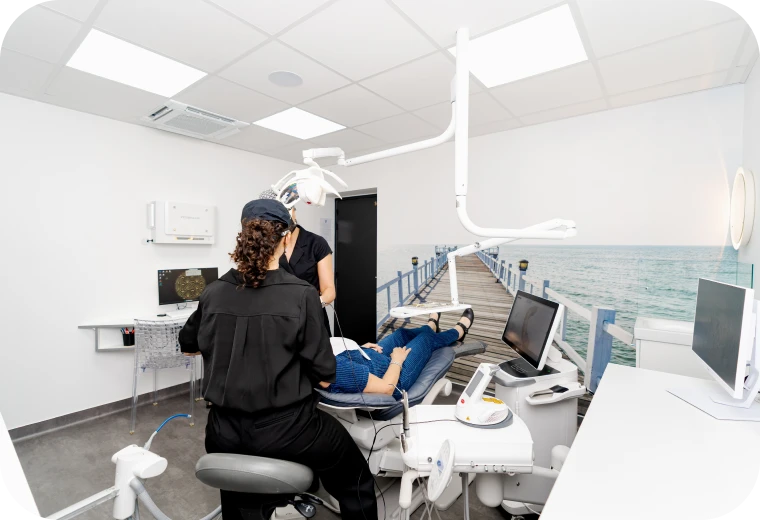
The examination also covers the condition of the enamel, the health of the gums and any existing restorations. Discolouration located in a groove or around an old restoration may require particular attention.
The examination also allows us to look for decay, a crack, leakage or another cause that could explain the discolouration.
This step helps to distinguish a surface stain from a deeper change. It also makes it possible to compare the different treatment options and explain their limitations.
Surface stains
Surface stains affect the outer layer of the enamel. They can appear gradually as a result of dietary habits, tobacco, certain products or a build-up of dental plaque.
In these situations, a professional cleaning may be indicated. Scaling removes tartar, while air polishing helps to remove certain external discolourations and fine deposits.
When the discolouration is purely superficial, more invasive treatment is not always necessary. The choice is based on the clinical examination, the condition of the teeth and the appearance you would like to change.
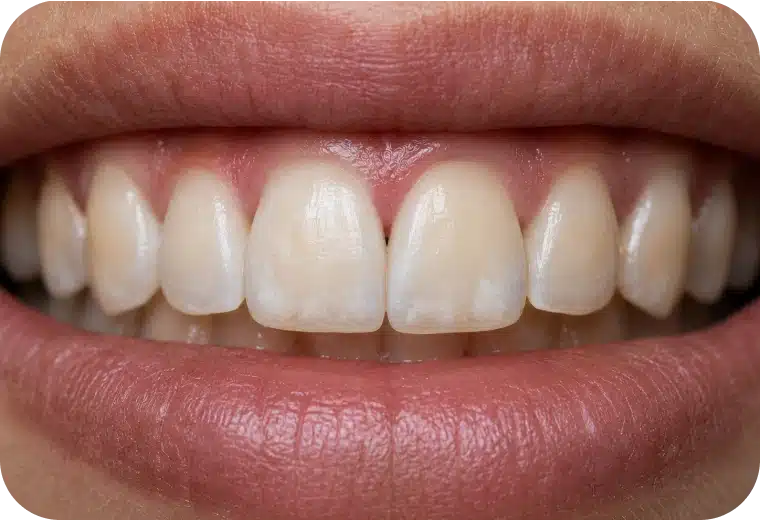
White spots
White spots can have several origins. They may be linked to a change in the enamel, to demineralisation, to an early decay episode in the past, or to a particularity that arose while the tooth was forming.
How they are managed depends on their depth, their stability and the quality of the enamel around the area concerned. Some spots can simply be monitored. Others may lead to discussing a localised treatment when the diagnosis justifies it.
Before any decision, the practitioner checks that the tooth is healthy and that the gums are free from inflammation. They also take into account the shade of the neighbouring teeth so as not to create a more marked difference in the smile.
Brown or dark stains
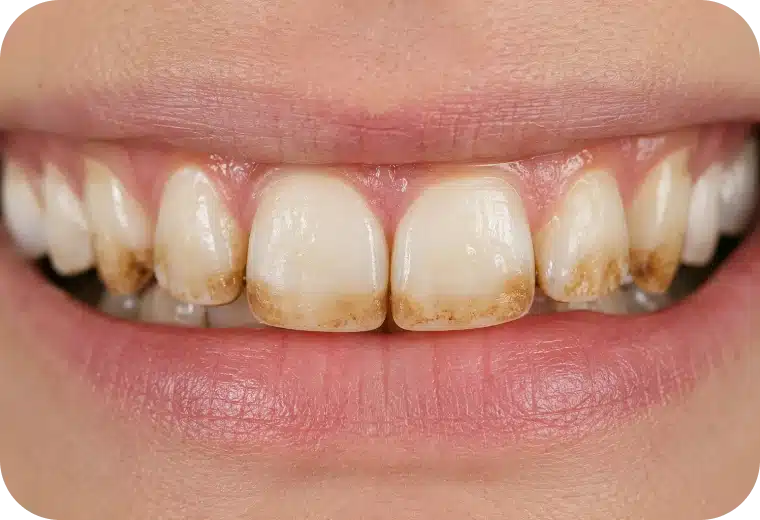
Brown or dark stains may be superficial, but they can also correspond to a deeper change in the tooth.
Discolouration located in a groove, around an old restoration or in an area that is difficult to clean must be assessed carefully. In particular, the practitioner checks for the absence of decay, cracking or leakage.
Depending on the origin of the stain, several approaches may be considered. These may include a professional cleaning, monitoring, replacing a restoration, whitening, or another treatment suited to the tooth concerned.
Professional cleaning, whitening or restoration: how to choose?
Treatment depends on the nature of the stain and on what the assessment reveals.
When discolouration lies on the surface of the enamel, scaling or air polishing can help to reduce it. When the discolouration affects the overall shade of the tooth, whitening is considered if the condition of the teeth and gums allows it.
A stain located within the enamel first requires its origin to be established so that treatment can be adjusted. A restoration may be indicated when the tooth has lost tissue, has a filling that needs replacing, or shows more extensive damage.
No solution is automatic. The aim is to choose an approach proportionate to the origin of the stain and to preserve healthy dental tissue as far as possible.
Preserving the balance of your smile
Treating a stain is not considered on the basis of the affected tooth alone. The shade of the neighbouring teeth, how visible the area is, the shape of the smile and your expectations must also be taken into account.
A highly visible stain can sometimes be reduced, but the outcome depends on its nature, its depth and how the tissues respond to treatment.

The aim is to achieve a consistent, harmonious smile without creating an artificial contrast. This analysis also helps to avoid treatment that would be disproportionate to the initial situation.
Preventing new discolouration
Some surface discolouration can reappear over time. How it develops depends in particular on dietary habits, tobacco, daily hygiene and the build-up of plaque or tartar.
Brushing, interdental cleaning and regular check-ups help to limit surface deposits. Scaling or air polishing may also be indicated depending on the needs observed.
When stains are linked to the structure of the enamel, prevention alone is not enough to make them disappear. It nevertheless remains important for preserving the health of the teeth and gums around the area concerned.
Care built around listening to what you want
A stain on a tooth can be a genuine source of discomfort day to day, even when it seems discreet. The consultation is an opportunity to explain exactly what bothers you and what you would like to change about your smile.
The possible solutions are presented to you together with their indications and their limitations. Treatment is then organised according to the diagnosis and the approach chosen.
Care continues after treatment with tailored advice and monitoring of how the tooth develops. This gives you clear points of reference for understanding the treatment and maintaining the result over time.
A consultation to understand the origin of stains
White spots, brown discolouration, an uneven shade or an old restoration that has become visible: a number of situations can prompt a request for an assessment.
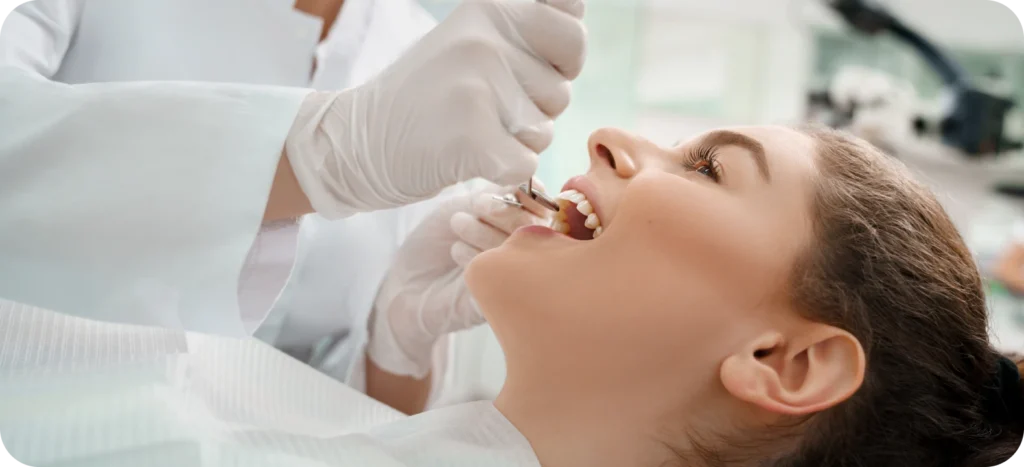
A consultation allows us to examine the teeth, the enamel, the gums and any existing restorations. It helps to identify the origin of the stains and to determine whether a professional cleaning, whitening, a localised treatment or a restoration can be considered.
Frequently asked questions
Can all dental stains be treated?
No. Management depends on the origin, the depth and the condition of the tooth concerned. Some stains can be reduced, while others require a different approach or simply monitoring.
What is the difference between a surface stain and a deep stain?
A surface stain sits on the outer layer of the enamel. A deeper stain is embedded in the structure of the tooth and requires a more precise analysis.
Is tooth whitening enough to treat stains?
Not always. Whitening mainly acts on the overall shade of natural teeth. A localised stain may require a different solution depending on its origin and its depth.
Can white spots be reduced?
Some white spots can be reduced. The result depends on their depth, their origin and the quality of the enamel.
Why carry out an assessment before treating a stain?
The assessment makes it possible to identify the origin of the stain, check the condition of the tooth and compare the available options. It avoids treating discolourations that have different causes in the same way.

